
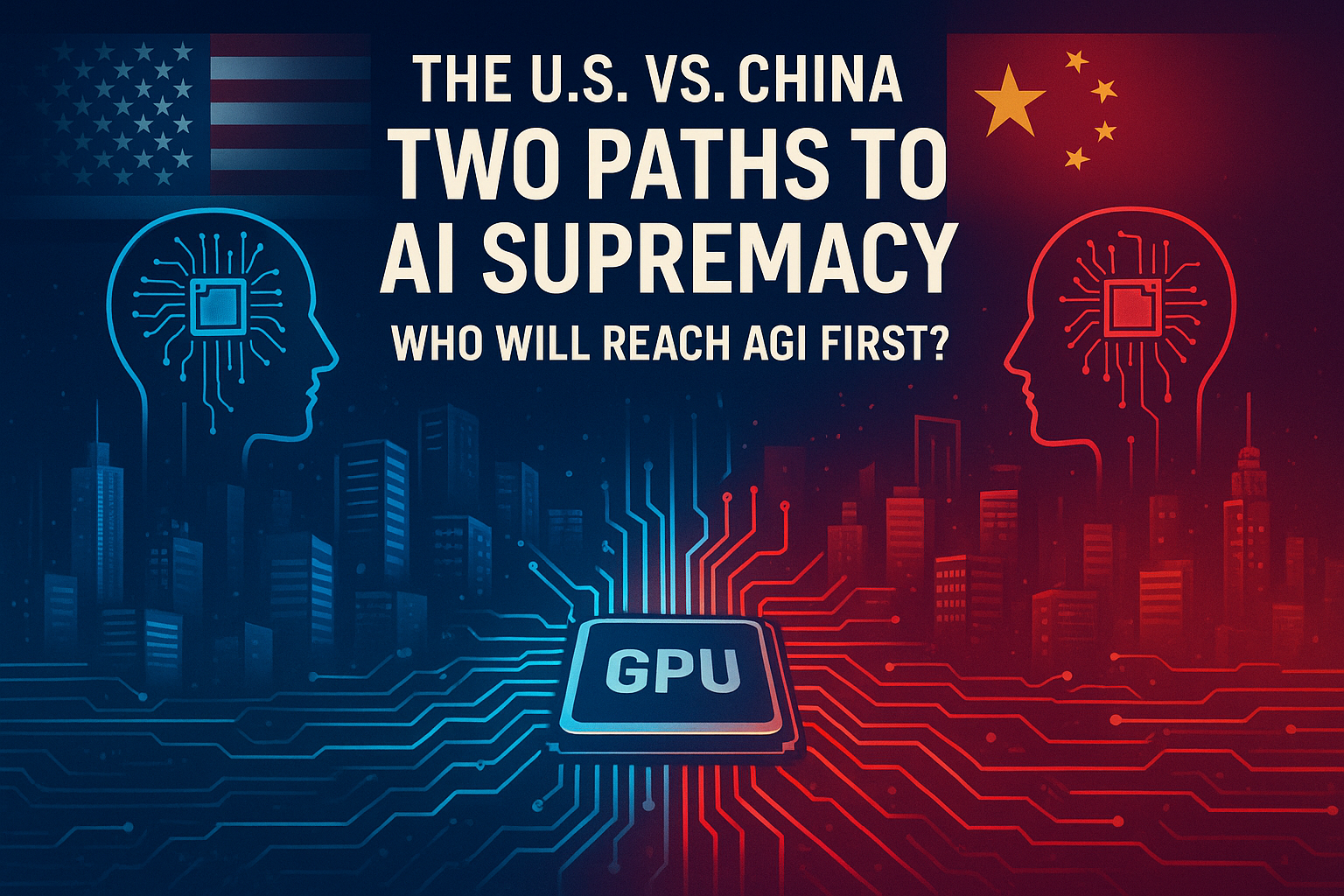
While the United States invests billions in building colossal AI supercenters and “AI factories” to develop the most powerful artificial intelligence models ever, China pursues a different route—optimizing AI for widespread use across its population of over a billion people. These contrasting strategies embody two distinct philosophies: America’s quest for “power-based AI supremacy” versus China’s vision of “AI for everyone.” Yet both are racing toward the same ultimate goal: Artificial General Intelligence (AGI).
🇺🇸 United States: Crafting the Brains of Tomorrow
From OpenAI and Anthropic to Elon Musk’s xAI, U.S. tech giants are rapidly assembling massive AI infrastructures powered by hundreds of thousands of Nvidia GPUs and data centers valued in the tens of billions. Their ambition extends beyond surpassing models like GPT-4 or Claude 3—they aim to push the frontier with AI systems capable of self-learning, self-improvement, and versatile reasoning across domains, laying the groundwork for true AGI.
Elon Musk once remarked:
“AI will soon be smarter than any human. Whoever controls the most compute will control the future.”
With unparalleled computing resources, a robust hardware ecosystem, and extensive corporate networks, the U.S. is building the world’s largest AI training foundation, poised to create models that think, invent, and decide far beyond current capabilities.
🇨🇳 China: Integrating AI into Daily Life
China, meanwhile, emphasizes embedding AI deeply into everyday society—from e-commerce and education to healthcare and public services. Leading companies like Baidu, Alibaba, Tencent, and ByteDance deploy thousands of medium- and small-scale AI models tailored for specific industries, regions, and enterprises.
China’s focus is on maximizing practical impact—making AI accessible and useful to every citizen, not just researchers or corporations. A Beijing AI researcher summarized it well:
“We don’t need one godlike AI — we need millions of useful ones.”
Leveraging an immense data ecosystem and nationwide deployment capabilities, China is creating the most socially integrated AI landscape on Earth, where people engage with AI daily—whether learning languages, farming smarter, or managing logistics.
⚔️ Two Paths, One Destination: Who Will Achieve AGI First?
While the U.S. aims to develop a singular super-intelligent AI, China is crafting a distributed AI network powered by collective intelligence. Which will succeed first?
The U.S. may achieve AGI sooner due to its overwhelming computing dominance and unified large-model strategy.
Conversely, China might realize a networked form of AGI emerging from billions of interconnected AI systems learning through real-world human interactions.
🔮 The Future: A Philosophical Battle Beyond Technology
The AI rivalry between the U.S. and China transcends technology—it’s a philosophical debate on how humanity should coexist with intelligent machines:
- A future governed by a singular superintelligence, or
- A future enriched by billions of human-AI partnerships working in harmony.
Ultimately, AGI may not belong exclusively to either nation. It could arise as a blend of both—America’s computational power combined with China’s societal integration. When that moment arrives, humanity will enter an era of “co-evolution with AI,” where artificial intelligence not only serves us but grows alongside us.
Leave a Reply